

 Apple Podcasts
 Spotify
 PocketCasts
 RV Loan Traps, Winnebago's Comeback, and What Our Own Fuel Price Poll Really Tells Us
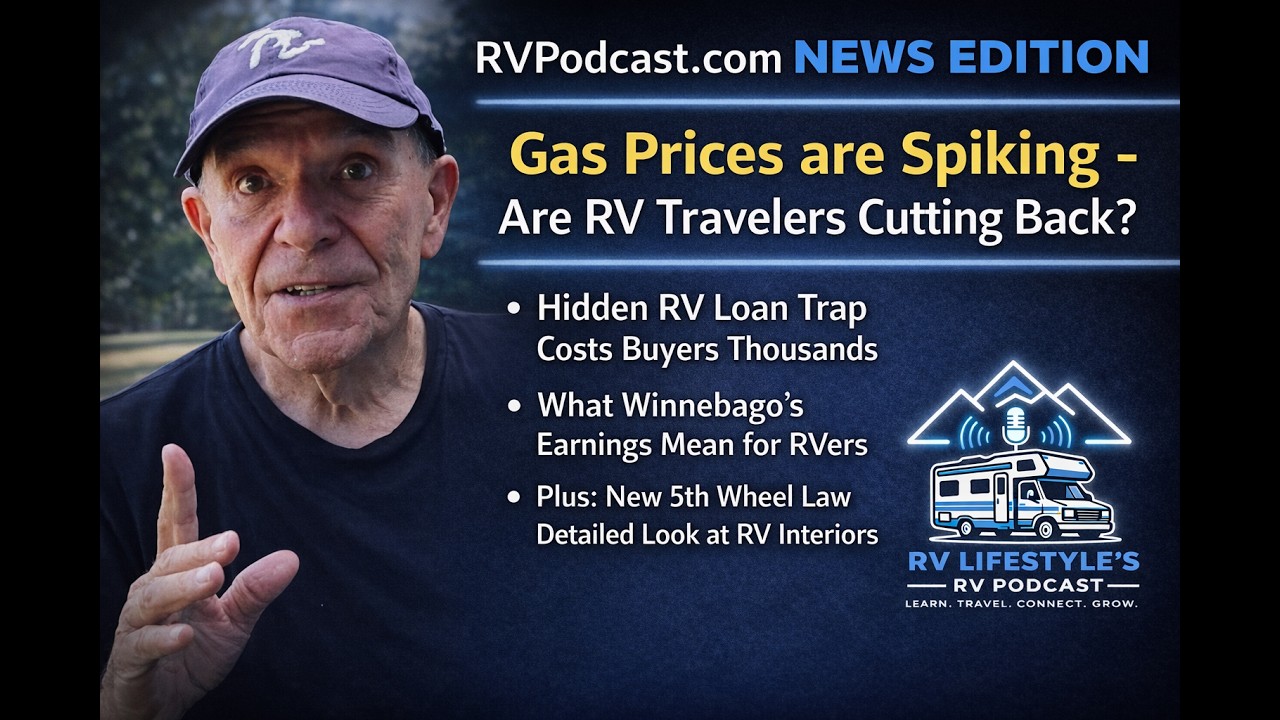
Gas prices are spiking - but are RV travelers actually cutting back? We asked our community, got more than 300 responses, and the numbers tell a surprising story. Plus: the RV loan trap that is costing buyers thousands without them knowing it, why Winnebago's latest earnings report matters to every RV owner and buyer, a behind-the-scenes look at the company that builds the insides of your RV and just invested seven figures in a giant design studio, and a new Washington State law that finally clears up a legal headache for fifth-wheel owners.
In this episode:
- The RV Loan Trap: how dealer financing really works, and how to protect yourself
- Winnebago is back in the black - and here is why that matters to you
- Patrick Industries debuts a massive digital design studio in Elkhart
- Washington State fixes the fifth-wheel length measurement mess
- Our community fuel price poll results: nearly two-thirds are not cutting back
All sources and show notes are at RVPodcast.com.
Subscribe for two new episodes every week - the Monday News Edition and Wednesday Stories from the Road.
Ready to plan your next adventure? Our RV Lifestyle Trip Planning Dashboard gives you everything in one place - routes, budgets, campgrounds, and checklists. One-time $29, no subscription. RVLifestyle.com/tripdashboard
Become a part of the Internet's Best RV Community
Private. Ad Free. No Facebook Nastiness.
RV Travel Tips, Rallies and Meet-Ups, interactive livestreams, exclusive workshops, perks, discounts and Real Help from Real Rvers.
RVPodcast News Edition for March 30, 2026
Title: RV Loan Traps, Winnebago's Comeback, and What Our Own Fuel Price Poll Really Tells Us
Good morning and welcome to the RV Lifestyle Podcast. I'm Mike Wendland, and this is the Monday News Edition - your weekly look at the stories shaping the RV world right now.
Six stories today, and they all matter. But let me explain how we do things here. I spent more than 30 years as a working journalist, and that discipline carries into everything we do on this show. Every story is sourced. No rumor, no speculation, no press release taken at face value. The links and documents we used to build each story are in the show notes, waiting for you at RVPodcast.com. We think you deserve to know where the information comes from. Go check the work. Follow the trail.
That's the journalism difference. Fifteen years in to this RVB Lifestye, it's still what we're most proud of.
But before we get to the news, a quick word about something we built because we needed it ourselves.
You know how trip planning goes. Campground reservations in one place, your route in another, fuel estimates scratched on a notepad, confirmation emails buried somewhere in your inbox. It gets messy fast - and Jennifer and I got tired of the mess.
So we built a fix. It's called the RV Lifestyle Trip Planning Dashboard, and it's exactly what it sounds like: a web-based app, works on any device, that pulls your entire trip into one place. Your route, your stops, your campground bookings, your budget, your rig details, your emergency info - all of it mapped out in a timeline so you always know what's coming next.
We use it on every trip now. If you want to check it out, head to RVPodcast.com/tripdashboard.
Alright. Let's get into the news.
All right.
Let’s get to our lead story this week.
Because I got an email a few days ago that I cannot shake…
Story 1: The RV Loan Trap: When the Dream Turns Into Debt
I got an email a few days ago that I can't shake.
A woman wrote to me from Florida. Her husband passed away two years ago. Before he got sick, they had bought an RV together for retirement. You know the plan - travel the country. Finally enjoy the freedom they had worked so hard for their whole lives.
They used that RV five times. Five.
Then life happened the way it always does when you least expect it. He got sick. The trips stopped. He passed. And for the past two years, that rig has been sitting in the driveway. Not moving. Not being maintained. Just sitting.
And if you've been in this lifestyle more than a few years, you know what that does to an RV. Tires age whether you drive them or not. Roof seals dry and crack. Systems fail. Batteries die. An RV that sits is often in worse shape than one that gets used hard.
So this woman is now facing two problems at once. The value has dropped significantly. The condition has very likely gotten worse. And she still has a loan on it. A big one.
She told me she needs to sell it just to stay in her home.
An RV that was supposed to represent freedom is now threatening the roof over her head.
I wish I could tell you this was rare. It is not. And the more I dig into how these deals get written, the angrier I get. Because what happened to her did not happen by accident.
So let me pull back the curtain on something that the big corporate RV dealerships count on you not knowing.
When you walk into a large volume dealership and finance an RV, you pass through what the industry calls the F and I office. Finance and Insurance. It sounds administrative. It is not. It is one of the most profitable rooms in the building, and for the buyer, it is often the most dangerous.
Here is how the rate game works.
The lender - a bank or finance company the dealer has a relationship with - gives the dealer what's called a buy rate. That's the actual interest rate you qualify for based on your credit. The dealer is not required to show you that number. Instead, they mark it up. Industry data shows the typical markup runs one to two and a half percentage points above what the lender actually approved. The dealer keeps the difference on every single payment you make for the life of the loan. It's called dealer reserve, and it is completely legal. They do not have to tell you it exists.
Run the math on a $60,000 fifth wheel financed over 15 years. A two-point markup on that loan can cost you an additional four to five thousand dollars in interest, paid quietly, invisibly, on top of what you would have paid if you had walked in with pre-approved financing from your credit union. MIT researchers who studied this system found that roughly 78 percent of dealer-arranged loans carry marked-up interest rates.
And the rate markup is just the beginning.
The other tool in that finance office is the monthly payment. It is the single most powerful way a high-volume dealer controls the terms of a deal without you realizing it.
The moment you say "I'm looking for something around $400 a month," the dealer has the number they need. They can now work backwards, adjusting the loan term - 10 years, 12 years, 15 years - until they hit that payment. The price of the RV goes up. The interest rate goes up. The term goes up. And the payment stays right around $400, so you never notice.
What you also don't notice, until much later, is that a long-term loan on a fast-depreciating asset is a trap. RVs lose value quickly, especially in the first few years. But a 15-year loan pays down slowly, front-loading interest in the early years when you still owe close to the full balance. So two or three years in, you may owe $55,000 on an RV now worth $38,000. That's called being upside down. And once you're there, you can't sell without bringing cash to the table. You can't trade without rolling that negative equity into the next loan and making the hole deeper.
That is the setup this woman in Florida inherited when her life changed.
And there is documented evidence this is not just a business model - in some cases, it crosses into fraud. Last December, Oregon's Attorney General settled with Camping World for $3.5 million after a multi-year investigation found the company advertised a heavily discounted price, then clawed back that discount during negotiations by double-charging customers for freight and preparation fees already included in the advertised price. Three million dollars of that settlement went directly back to affected customers. A signed settlement agreement. Not a rumor.
Now, to be fair, not every dealership operates this way. There are independent dealers across this country - family-owned operations where someone actually walks you through the depreciation curve, explains what you'll owe in three years compared to what the rig will be worth, and tries to match you with the right loan for the right amount of time. We have met many of them. They are real and they are good.
But the large corporate chains run on volume. Their finance departments are measured on per-vehicle profit, and the finance manager is often the highest-compensated person in the building. The system is built to extract. And the buyer who walks in excited about the lifestyle, focused on the floor plan and the slideouts, is at a significant disadvantage against people who do this 20 times a day.
So here is what you can do.
Get pre-approved. Before you ever set foot on a lot, go to your bank or credit union and get a rate in writing. That single step removes the dealer's biggest leverage point. If the dealer can't beat that rate, use your own financing.
Never negotiate from a monthly payment. Negotiate the total price of the RV first, your trade-in second, and financing third, as three separate conversations. The moment you bundle them, the dealer controls the math.
Ask what you'll owe in three years compared to what the RV will be worth. Ask it directly. If they can't or won't answer, walk.
And if the only way a deal pencils out is by stretching the loan to 12 or 15 years, treat that as a warning, not a solution.
Because the RV lifestyle is supposed to be about freedom. About open roads and new places and time well spent. That woman in Florida bought into that dream, exactly the same as most of you listening right now. The dream was real. The deal that funded it was not built in her favor.
Don't let that be your story.
Sources:
-
Oregon AG $3.5M Camping World settlement: https://www.koin.com/news/oregon/camping-world-reaches-3-5-million-settlement-after-double-charging/
-
NerdWallet on dealer reserve/rate markup: https://www.nerdwallet.com/auto-loans/learn/dealers-profit-off-financing
-
MIT research on dealer loan markups (78% of dealer-arranged loans carry markups): https://economics.mit.edu/sites/default/files/2023-02/autoloans%20new%20version.pdf
-
RV dealer F&I profit analysis: https://www.rvnews.com/opinion-leading-your-fi-team-a-guide-for-dealership-success/
-
How RV dealers make money: https://www.bishs.com/blog/4-ways-rv-dealers-make-money-and-how-to-not-get-taken-advantage-of/
-
Dealer reserve explained: https://www.thevantagegroupauto.com/blog/dealer-financing-secrets-what-to-know
-
LendingTree on RV loan terms: https://www.lendingtree.com/auto/rv/
STORY 2: DEF GOOD NEWS FOR DIESEL RV OWNERS
Here's a quick win for those of you driving diesel motorhomes - and this just happened Thursday.
President Trump just announced on Thursday the EPA is fixing a problem that has been a genuine nightmare for diesel vehicle owners for years. If you have a diesel pusher, a diesel Class C, or a diesel pickup towing your rig, you've probably heard of DEF - Diesel Exhaust Fluid. You add it to a separate tank, it helps control emissions, and you've been living with it.
The problem wasn't the fluid itself. It was a sensor that monitored it. That sensor turned out to be one of the most failure-prone components in modern diesel engines - and when it failed, even when nothing was actually wrong, the engine would go into what's called "limp mode," cutting your power or slowing you to a crawl. We're talking five miles per hour on the interstate. In your motorhome. That's not just an inconvenience - that's a safety hazard.
The EPA is now scrapping that problem sensor entirely and replacing it with a more reliable one that monitors actual exhaust rather than the fluid in the tank. Manufacturers can now push software updates to existing engines to make that switch - and those updates won't be considered illegal tampering under federal law.
Now - I know what some of you are thinking. Does this mean we can finally get rid of DEF altogether? The short answer is no. The EPA was clear: today's announcement does not weaken or remove emissions standards. The change is about how compliance is achieved, not whether it's required. DEF is staying. But the sensor that kept triggering false alarms and stranding rigs? That's gone.
Watch for a software update notice from your engine manufacturer. When it comes - get it done.
SOURCES:
-
EPA official press release, March 27, 2026: epa.gov/newsreleases/trump-administration-announces-latest-action-address-diesel-exhaust-fluid-def-system
-
Camper Report - RV-specific coverage, March 27, 2026: camperreport.com/epa-eliminates-def-sensor-requirement-on-diesels
-
CDL Life - trucking industry detail, March 27, 2026: cdllife.com/2026/epa-removes-def-sensor-requirement
-
RV Travel - background on the derate problem for motorhome owners: rvtravel.com/motorhomers-alert-epa-proposes-def-derate-rules-1052b
STORY 3: WINNEBAGO IS BACK IN THE BLACK - AND THAT MATTERS TO YOU
Let's talk about Winnebago.
For the past couple of years, I've been covering the RV industry's rough patch - Camping World bleeding red ink, Thor restructuring, manufacturers laying off workers in Elkhart. So when a genuine bright spot shows up, I think it's worth our time.
Winnebago just reported its fiscal second quarter results, and for the first time in a while, the headline is actually good. The company posted $657 million in revenue - up 6 percent from a year ago - and returned to profitability, recording $4.8 million in net income after posting a loss in the same quarter last year. On top of that, they beat what Wall Street was expecting, on both revenue and earnings per share.
The real story inside those numbers is the motorhome segment, which saw a 29 percent jump in revenue. That's not a rounding error. That's a genuine shift in demand.
CEO Michael Happe put it this way: the company is on solid footing heading into the second half of the year. He did acknowledge the industry recovery is, in his words, "stubborn" - so nobody's popping champagne yet. The overall RV market is still climbing out of the post-pandemic correction. But Winnebago's momentum is real.
So why does this matter to you as an RV owner or buyer?
A few reasons. First, Winnebago is not a fringe player. They make everything from entry-level travel trailers to premium Class A motorhomes, and brands like Newmar, Grand Design, and Chris-Craft are under their umbrella. When they stabilize, a big chunk of the RV market stabilizes.
Second, a financially healthier Winnebago means better warranty support, longer model runs, and more investment in quality control - all things that directly affect you after the purchase.
And third, if you're shopping for a motorhome right now, this data tells you that demand is firming up in that segment. The window for rock-bottom deals may not stay open forever.
For a company that was posting losses a year ago, this is a meaningful turnaround. Not a boom. Not a victory lap. Just a manufacturer getting its footing back in a market that's been punishing for three years.
And after everything we've covered on this show about industry struggles, a little good news is worth noting.
Sources:
-
https://moderncampground.com/usa/winnebago-industries-reports-second-quarter-fiscal-2026-revenue-growth-and-improved-profitability
-
https://www.globenewswire.com/news-release/2026/03/25/3262067/0/en/Winnebago-Industries-Reports-Second-Quarter-Fiscal-2026-Results.html
-
https://www.investing.com/news/transcripts/earnings-call-transcript-winnebago-beats-q2-2026-earnings-expectations-93CH-4580715
STORY 4: THE COMPANY INSIDE YOUR RV JUST BUILT A GIANT TV STUDIO TO DESIGN BETTER RIGS
Here's a name you probably don't think about much: Patrick Industries.
You've almost certainly never seen their logo on the side of an RV. But if you've walked through a fifth wheel or a Class A recently, Patrick Industries was probably responsible for the cabinetry, the wall panels, the countertops, the flooring, the lighting components, possibly the bed frame - even the furniture. They supply components to just about every major RV manufacturer in the country, from Thor to Winnebago to Forest River. They have 85 brands under their roof and more than 10,000 employees. They are one of the most important companies in the RV world that most RV owners have never heard of.
This week, they unveiled something genuinely interesting.
Patrick just opened what they're calling "The Experience" at their design center in Elkhart, Indiana - and the centerpiece is a 50-foot-wide by 14-foot-tall LED screen that allows RV manufacturers to walk into a room and see a full-scale, photo-realistic virtual version of an RV interior before a single part gets built. They can swap out flooring. Change the cabinet color. Adjust the lighting. Rearrange the floor plan. All in real time, life-size, on that screen.
And here is the line that jumped out at me. Patrick's vice president of design said: "Before this, the industry takes weeks and months to run prototypes. Now, customers can come in here and make decisions real time, life-size, and only have to run one prototype instead of ten."
Their president backed that up: manufacturers who've already used it have completed in two or three days what used to take two to three weeks.
Patrick says their investment was north of seven figures - and they're offering access to RV manufacturers at no charge.
So what does a big LED screen in Indiana have to do with the RV you're buying or already own?
Think about it this way. The interior of your RV - what it looks like, how it functions, how durable the materials are - gets decided in a design process that, until now, was expensive, slow, and prone to last-minute changes driven by the cost of physical prototyping. Manufacturers often cut corners or make compromises late in the process because redoing a physical mock-up is costly and time-consuming.
If Patrick's system works the way they say it does, manufacturers can now make better decisions earlier, iterate faster, and potentially deliver a more refined product to the dealership lot. The customer who buys that rig two years from now may never know this room existed - but they might notice the cabinets fit a little better, the lighting is a little more thoughtful, and the floor plan makes a little more sense.
That's a behind-the-scenes story, but it's a real one.
Sources:
-
https://ir.patrickind.com/investor-news-events/press-releases/detail/302/patrick-industries-inc-debuts-first-of-its-kind-digital-design-studio-for-rv-marine-and-powersports-industries
-
https://rvbusiness.com/patrick-ind-debuts-the-experience-digital-design-studio/
-
https://www.wndu.com/2026/03/26/patrick-industries-unveils-new-digital-design-studio-elkhart/
STORY 5: FIFTH-WHEEL OWNERS IN WASHINGTON STATE, THIS ONE'S FOR YOU
If you tow a fifth wheel and you've ever traveled through Washington State - or planned to - here's a piece of news that actually matters on a practical level.
Washington just signed a new law that fixes a headache that's been quietly frustrating fifth-wheel owners and dealers in the state for some time.
Here's the background. Washington has a 46-foot limit on fifth-wheel trailer length. Sounds straightforward. The problem was how that 46 feet was being measured - specifically, where the measurement started. Because a fifth wheel connects to the truck via a kingpin that sits over the rear axle, there was genuine confusion over whether the length was measured from the front of the trailer, from the kingpin, or from some other point. Different interpretations led to different enforcement outcomes, and it created a situation where dealers weren't sure which units they could legally sell, and owners weren't sure whether their rig was technically legal to drive through the state.
Washington Governor Bob Ferguson signed House Bill 2467 on March 16th, and it takes effect June 11th. The law is simple and clean: fifth-wheel trailer length is now officially measured from the center of the kingpin to the rearmost extremity of the trailer. That's it. One standardized measurement. No more guesswork.
The bill was pushed by a coalition of RV dealers in Washington who had been sounding the alarm about this issue for a while.
Now, you might be thinking - I don't live in Washington, why do I care?
Fair question. A couple of reasons. First, if you travel the Pacific Northwest, which is one of the most spectacular RV destinations in the country, you want to know your rig is legal and documented as such before you cross the state line. Second, this is how good RV policy is supposed to work. A real problem gets identified by real dealers working with real customers, the industry association advocates for a fix, and the state responds with a sensible, clear solution. That's worth acknowledging.
And frankly, if you own a longer fifth wheel - say, 40 feet or more - this kind of legal clarity has a direct effect on where you can confidently travel without wondering if a state trooper is going to interpret the rules differently than the dealer who sold you the rig.
It is a narrow story, but it's a real one. And the RV owners it affects will be very glad it finally got fixed.
Sources:
-
https://moderncampground.com/usa/washington-enacts-fifth-wheel-length-measurement-law-with-passage-of-house-bill-2467
-
https://rvbusiness.com/rvia-applauds-passage-of-fifth-wheel-length-bill-in-washington/
STORY 6: OUR POLL RESULTS - HOW FUEL PRICES ARE AFFECTING YOUR SUMMER RV PLANS
Alright, we asked. You answered. And the results are in - and frankly, they tell a pretty compelling story about just how resilient the RV community really is.
Last week, with fuel prices spiking again - driven in large part by the ongoing conflict in the Middle East - we put a straightforward question to our RV Lifestyle community: "With the sudden increases in fuel prices, are you cutting back your summer travel plans, expanding them, or keeping them the same?"
More than 300 of you responded. And here are the numbers.
38.5 percent said they are keeping their plans exactly the same. 24.4 percent - and this one might surprise you - said they are actually expanding their summer travel plans. And 37.2 percent said they are cutting back.
Now, before we talk about what those numbers mean, let me put on my old journalism hat for a second. 300 responses is not just a decent sample size. It is, statistically speaking, a reliable one. When you survey 300 people randomly, your results will typically fall within 5 to 6 percentage points of what the entire population actually thinks, 95 percent of the time. That is what pollsters call a 95 percent confidence interval. And in the research world, 300 responses are routinely considered more than sufficient for major business decisions.
So these are real numbers. Not just a show-of-hands. This is data.
And here is what that data actually tells you.
Add up the "same" and the "expanding" columns - 38.5 and 24.4 - and you get 62.9 percent. Nearly two thirds of RV travelers in our community are either holding steady or leaning in harder this summer, higher gas prices and all.
Put another way: only about one in three - 37 percent - says fuel prices are causing them to pull back. That means for every person scaling down, two people are not budging, or are actually doing more. That is not the picture of a community in retreat. That is a community with a commitment to this lifestyle that runs a whole lot deeper than the price per gallon at the pump.
And our numbers line up with broader reporting. RV Business noted just this week that while some RVers are adjusting their travel plans due to rising gas prices, not many are canceling them outright.
That tracks perfectly with what our own community told us.
There is also some context worth keeping in mind. Even when gas prices hit their peak back in 2022, the added fuel cost for an average RV trip was only around $40 - roughly the same as a single carry-on bag on most airlines. RV travel, even with higher fuel costs, remains one of the most cost-effective ways to travel in America when you factor in accommodations, meals, and the freedom to go where you want, when you want.
The bottom line from our poll? Fuel prices would have to climb considerably higher - and stay there - to put a serious dent in summer RV travel. Right now, the RV community is absorbing the hit and rolling on down the road. That is not stubbornness. That is a lifestyle that people have committed to, planned for, and are not walking away from over a bump at the gas pump.
We will keep watching those prices, and we will keep asking you the questions that matter.
Sources:
-
RV Lifestyle Community Poll, March 2026 (300+ responses)
-
RV Business - "Some Adjusting RV Travel Plans Due to Rising Gas Prices": https://rvbusiness.com/some-adjusting-rv-travel-plans-due-to-rising-gas-prices/
-
RVshare 2026 Travel Trend Report / Gas Rebate Announcement: https://rvbusiness.com/rvshare-gives-away-1m-in-gas-to-encourage-rv-travelers/
-
KKTV - "Gas Prices Rise as EPA Expands Summer Fuel Options": https://www.kktv.com/2026/03/27/gas-prices-rise-epa-expands-summer-fuel-options/
CLOSE
And that’s going to do it for this week’s RV Podcast News Edition.
Before we go, I want to remind you about our next live, interactive workshop coming up April 16.
It’s called Never Miss a Campsite Again: How to Book Campgrounds Without the Stress.
If you’ve ever tried to grab a site at a popular campground and watched everything disappear in seconds, you know exactly how frustrating that can be. In this workshop, we’re going to walk you through the exact strategies, timing, and tools we use to consistently get the sites we want.
It’s live, it’s interactive, you can ask questions, and we’ll make sure you come away with a real plan you can use right away.
You can sign up right now at RVLifestyle.com/workshop.
Also, a quick reminder, we release two episodes of the RV Podcast every week.
On Mondays, it’s this, the News Edition, where we break down what’s happening across the RV world.
And on Wednesdays, it’s Stories from the Road, where we share great destinations, interviews, and real-world experiences from fellow RVers.
Make sure you’re subscribed so you don’t miss either one. You can find us on YouTube, or in your favorite podcast app, just search RV Podcast.
And as always, you can find all our notes, links, and resources for this episode over at RVPodcast.com.
Thanks so much for listening.
I’m Mike Wendland.
And we’ll see you next time, out there on the road.
Happy Trails.
Subscribe for two new episodes every week - the Monday News Edition and Wednesday Stories from the Road.